Localization and investing in what lasts: locally-led development and ex-post learning
This year-end blog highlights learning from the Climate Investment Funds (CIF), IRC/ CARE, about what can work, what needs more resources, learning from what didn’t, OCHA challenging assumptions and RI data, bring true localization, and sustainability/ resilience learning for Adaptation Fund (CF) to come.
1. CIF’s PPCR and ARISE programs
A final, summative evaluation of a $1.2 billion Climate Investment Funds (CIF) 10-year programme, the PPRC, that I and Valuing Voices evaluators were involved through ICF has led to inspiring learning on local leadership and investments in nature-based solutions (NbS). We did three ex-post evaluations of work in Samoa, Bangladesh and Mozambique which i mentioned in this 2025 blog. The CIF used our evaluation findings for both a management response and learning and follow-on programme design.
The learning is shown in their management response to our recommendations including on Sustainability:
* “Management agrees that future programs should give greater attention to sustainability from the outset by improving design and exit planning to ensure that project outcomes, institutional capacities, and partnerships remain effective beyond project completion.
* To sustain results over time, Management agrees to foster local ownership, build institutional and technical capacities, and mobilize resources for operations and maintenance, which were found lacking in operations and maintenance across the three ex-posts.” These drew on our ex-post evaluation findings:
* “Also, Management acknowledges the value of maintaining robust monitoring, evaluation, and learning systems to enable adaptive program and project management and support sustainability….
* Building on the country led monitoring processes, introduced within the PPCR, future programs will explore opportunities for supporting further monitoring and evaluation to better understand the factors that contribute to long-term resilience in the face of increasing climate risks and uncertainties.”
They used, among other lessons, ex-post findings in the design of the ARISE programme (Accelerating Resilience Investments and Innovations for Sustainable Economies), This includes key learning like “CIF will continue to promote a systems-oriented approach and adaptive design frameworks that link national, sub-national, and local interventions…[and] encourage inclusive engagement of local stakeholders,particularly disadvantaged and climate-vulnerable groups.” They also heard us about local Ownership: “Champion locally-led adaptation solutions, empowering communities to drive innovations and deliver lasting impact – with inclusive, scalable funding approaches rooted in communities most affected” and “Countries being in the driver’s seat is the best way to set priorities. Some PPCR countries chose smart agriculture, others infrastructure and flood protection, or early warning systems…” They also chose to listen to community desires for sustainable solutions, including lessons from Mozambique: “Install solar-powered, efficient irrigation to conserve water and maintain productivity”,
2. IRC & CARE Congo’s Community Driven Development (CDD)
5 years after a 4-year CDD programme called Tuungane 1 in Eastern Congo closed, they found “evidence as to its effects remains inconclusive.” It had two components: 1) an intervention at the VDC (village development committees) level that involved $3,000 grants, and 2) further $50,000 to $70,000 sub-grants to undertake infrastructure projects such as the construction of schools and hospitals. A key element was a focus on women’s empowerment and on championing the rights and roles of women in collective decision-making. A robust evaluation of 781 villages found that while “the program had a positive [output] on the quality of primary schools and health facilities, and on the presence of material and supplies in these facilities… villagers living in areas that received Tuungane 1 have education and health facilities nearby that are built and stocked better than in areas the program did not focus on.
Yet they found no evidence for improvements in education outcomes or long-term impact(s):
“We find no evidence that the program had an effect on other dimensions of service provision: capacity, staff quality, quality of administration, community participation, service cost or utilization.” They determined that it was a dearth of resources invested into salaries and costs”: “Teachers and nurses still received very little compensation for their work…. [and] Many individuals mentioned that prohibitive prices remained a central obstacle for making of use educational or
health services….
We do not find positive economic effects and even see some (generally scattered) evidence suggesting adverse economic effects.
Finally, when it comes to the role of women, the evidence does not suggest that Tuungane 1 led to improvements in women’s empowerment.”
Many programs do that show that an insufficient investment in only “gender quotas, which increase the number of women in leadership positions, may not be sufficient to alter entrenched gender roles and norms.” Such gender roles are complex and ‘just’ making sure women are participating is not enough. This is a common finding across many ex-post evaluations. Doing ex-post evaluations shows how to design better, and foster locally-led development in fact, not theory. Kudos for publishing valuable, if disappointing, results.
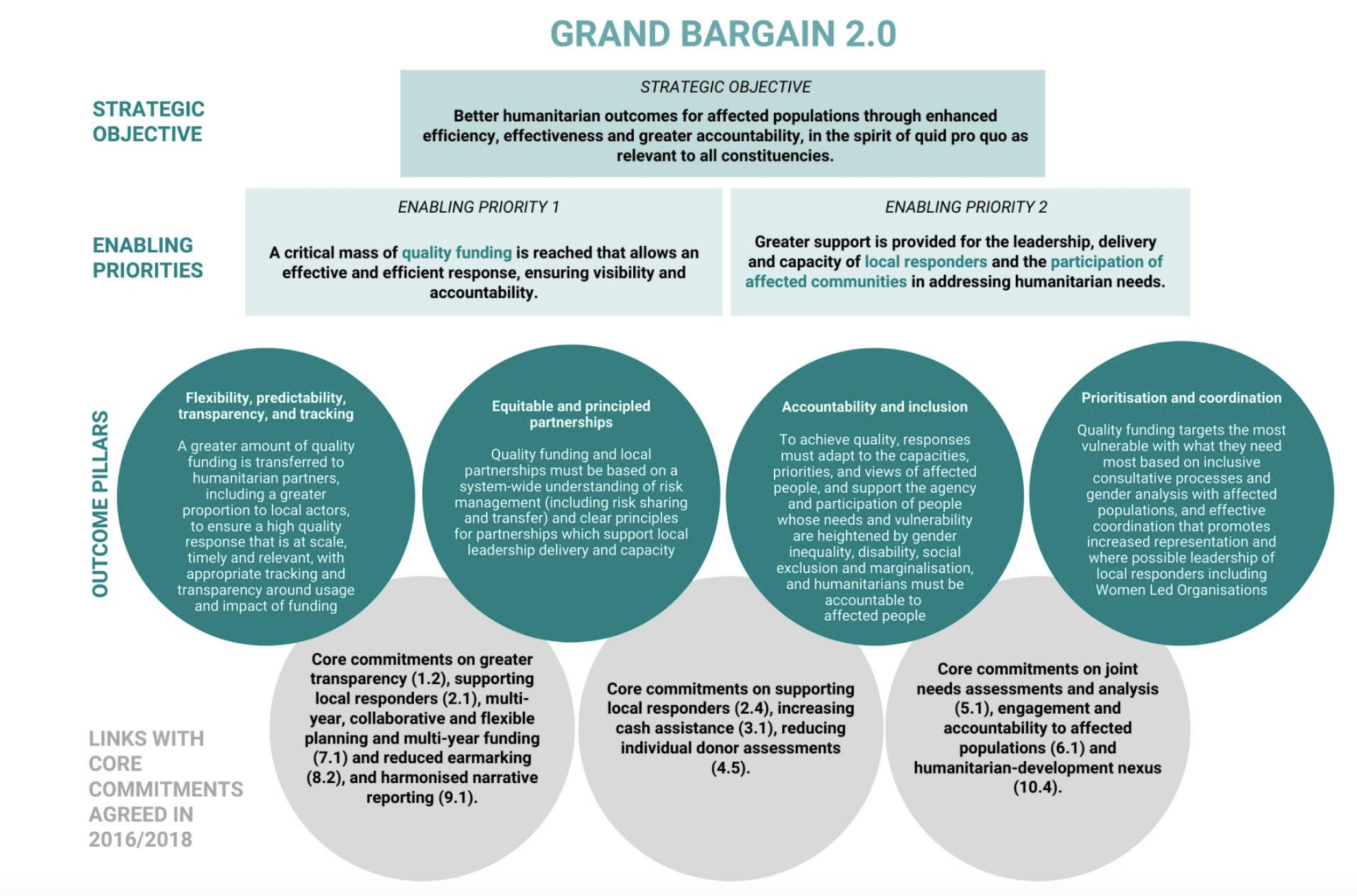
3) OCHA leadership created a Grand Bargain 2.0 in 2021, it is high time it is implemented de facto.
“Approaches and methodologies to localization of ‘sustainable development’ programming must be promoted so that local NGOs can take ownership of such approaches and start implement them. Most aid agencies don’t have yet the know-how to implement such a “localization approach” as this requires a complete change in the way they operate. This would also imply to “educate” donors on this new way of working as being initially more time consuming in terms of planning, and would require a “power change” from the humanitarian “elites” to the local communities and authorities….
The concentration of monetary resources at the top facilitates accountability to global north donors at the expense of accountability to aid recipients. Humanitarian elites wield power by dominating the discourse that sets the agenda for action, notes scholar Sheila Nair. Meanwhile, power imbalances in humanitarian governance tend to exclude local communities from direct funding and leadership opportunities….How much are organizations excluded? “Even where international organizations have adopted localized funding models, international-local partnership practices remain highly hierarchical. In a 2019 survey by the Accelerating Localisation through Partnerships consortium, only 24% of local and national NGOs said international-local partnerships seemed ‘genuine’….
While the Grand Bargain has not yielded significant results, local groups are busy enacting change outside of formal international frameworks. ODI’s July study identifies bottom-up action as the driving force for the most significant localization shifts during the [COVID] pandemic. Standout initiatives include an informal coalition of Red Cross national societies in the Pacific region that draws from their collective resources and expertise to improve local capacity and access to funding. And in the Democratic Republic of Congo, Santé & Développement emerged as a grassroots effort to address pandemic-related needs with the support of locally raised funds.” In fact, “While Grand Bargain signatories pledged by 2020 to give at least 25% of humanitarian funding to local and national stakeholders, only a tiny fraction of that — just 1.2% in 2022 — went directly to local and national groups.”
Localization is cheaper (as mentioned in 2015’s American Red Cross Haiti $500 million scandal) and must now become the priority, especially given research RI cites, that “local organizations are delivering assistance that is 17% more cost-efficient on average. Global data suggests that this figure could be as high as 32% for large U.N. and INGO budgets.” They go on to note that “The system must stop treating local organizations as subcontractors and meet them on equal terms as partners who lead…. ”
Given aid cuts, localization may be the (best?) last resort, and possibly the most sustainable.
4) Adaptation Fund’s ex-post adaptive sustainability and resilience learning continues
Finally, I am excited that in spite of a challenging funding environment, our ICF team has been selected by the Adaptation Fund (AF) to lead its 8th ex-post evaluation. This 5 years post-closure is of an $8 million water project run by Government of Ghana’s MEST and UNDP, of Increased Resilience to Climate Change in Northern Ghana through the Management of Water Resources and Diversification of Livelihoods. I am team lead under ICF Director Jessica Kyle and with the help of Isabel Morford-Cheibub, with an excellent Ghanaian expert Dr Martha Aata-Asantewa. We will be examining sustainability drivers, including local ownership, resources, partnerships, capacities and resilience characteristics as well as looking to learn from emerging outcome pathways to adaptive sustainability. Excited to share more lessons in 2026!
I’ve been focusing on sustainability and reframing impact from the perspective of nature, thanks to lessons about the earth’s carrying capacity and tipping points being breached. I’ve learned about this thanks to my environmental colleague Margaret Spearman and others like Scientists Rebellion. I have also learned more while managing our 150-year old family forest (Lesy Cekanova) which I have been diversifying, naturally regenerating, and trying desperately to fell as little of as possible so more trees could provide the ‘ecosystem services’/ return on environment (ROEn) as possible to us all (more on Ecosystem Services, which is “any benefit that humans get from nature” (EU). Why? Because I know our 540ha (1335acre) forest is under threat, as are the rest of our planet’s 12 million species including humanity.
The EU writes, “Ecosystems services offer benefits such as the pollination of crops, clean air, a reduction in extreme weather, human mental and physical well-being, wood for construction, fossil fuels, fresh water, tourism, science, education, recycling, fertilizer, carbon capture, outdoor sports, lakes, flood protection, hydroelectric power, and decomposition of wastes. It’s hard to put a value on every way that rocks, forests, beaches, woods, plants and animals help our lives. But we can put an economic value on the combined benefits of the world’s ecosystems.”
Also, as a Buddhist, I know that we humans Are nature, indivisibly connected. So harming nature harms us.
What are ways in which we are investing in retaining nature? The ideals are investing in the oceans, but on land, carbon credits voluntary markets mostly focus on forests (selling the ability of trees to absorb our CO2). But while they are great additions to vitally needed decreasing emissions or sequestering carbon, industry claims that these offsets support planetary sustainability need checking. A new Oxford Uni/U of Pa study showing Carbon offsets have failed: “These junk offsets—the ones not backed by permanent carbon removal and storage—are a dangerous distraction from the real solution to climate change, which is rapid and sustained emission reductions” and they recommend that the Oxford Offsetting Principles, which “encourage companies to reduce emissions first and foremost, and to transition to durable, carbon removal offsetting for residual emissions.” Yes, AND that’s what we evaluators are for: MRV, which is monitoring, reporting and verification! I answered on Linkedin today “When there is not good faith participation with the landowners not planting monocultures and locals not cutting down what grows, it is inevitable. There needs to be robust MRV. And transparency. As a forest owner, I am looking into selling carbon credits and if we get income from it, it means we can finally stop seeing trees’ only value as cash and wood once they are felled. I’m a huge fan of carbon credits because it will decrease the amount we need to cut while still caring for our forest sustainably by giving us money to invest in a more diverse forest which serves a wide range of ecosystem services needs. A mindshift needs to happen to include – even prioritize – what nature gets from our investments, given how we’ve ravaged it.
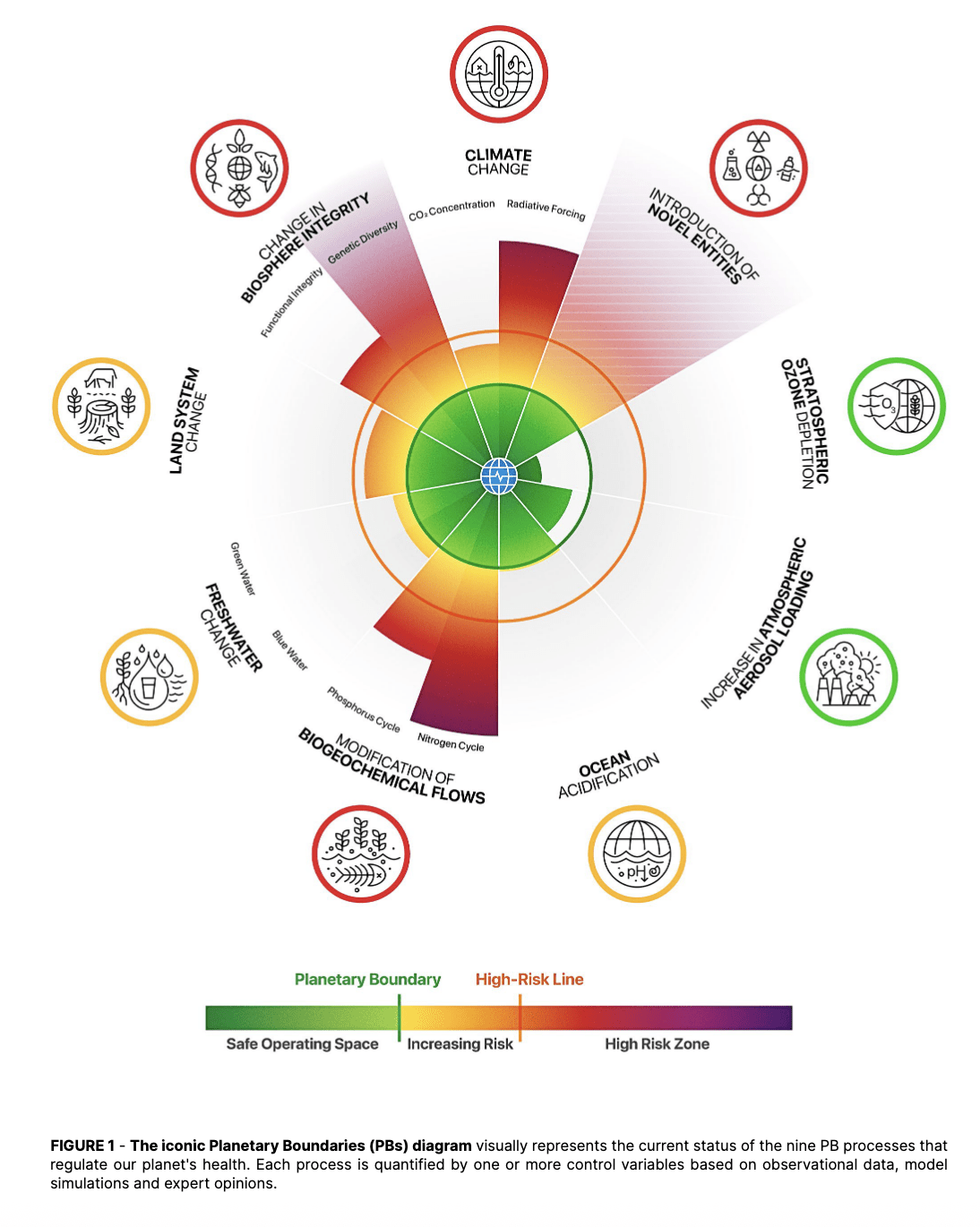
As the Planetary Health Check 2025 report states, we are in trouble, breaching 7 of the 9 planetary boundaries.
Yet “the solutions are just as important as the diagnostics of the state of the planet. It is encouraging that a growing number of actors around the world are beginning to put the boundaries into action. From national biodiversity strategies to companies setting sciences-based targets – the boundary framework can inform real-world decisions,” said Norström.
So, join us to discuss how to implement real sustained impact measures, Return on Environment and Environmental Continuum! You could see the talk I gave in Oslo (short version of the keynote here) or join us for an expanded version and discussion with investors on 20 October with Margaret at the Global Rethinking Finance Collaborative (GFRC Futures Fair Overview and registration & Agenda). Also, there are nearly 50 amazing “Investable Initiatives and Catalytic Enablers” pitching to investors via GRFC – Building Better Bridges ranging from agriculture & forestry, desalinization, nature restoration & ILM, solar, distributed carbon-negative manufacturing, architecture, affordable housing, waste management & wealth care etc in Africa and Asia! Come along!
Adaptive Sustainability lessons the Climate Investment Funds’ PPCR evaluation, including three ex-posts
We have evaluated less than 0.002% of how well and long results last (at least USAID data before the DEC disappeared). Hence we need to do more. I am excited to share our latest Climate Investment Funds (CIF) Adaptive Sustainability report including three ex-post evaluations conducted by our Valuing Voices teamfor ICF in Samoa, Bangladesh, and a former colleague in Mozambique (Appendix E). They are part of the PPCR project’s evaluation of this “$1 billion Pilot Program for Climate Resilience (PPCR) [that] champions pioneering resilience strategies and approaches, in the countries and regions most vulnerable to the destructive impacts of climate change”. We evaluated sustainability, climate resilience, and transformation, building on ex-post evaluation work done at the Adaptation Fund with Margaret Spearman. I reviewed nearly 40 other country reports to identify the drivers of sustainability and did intensive ex-post evaluations3-5 years after closure in this Final report (April 2025) just published.Sincere thanks to the excellent ICF team (Jessica Kyle, Isabel Morford-Cheibub with Laura Kuhl) and the CIF team for this learning opportunity.
More broadly, here are sustainability and resilience-relevant lessons from the final report summary findings:
“The PPCR’s stated goal is to integrate climate resilience into countries’ core development planning and provide incentives for scaled-up action and transformational change, and was also meant to pilot and demonstrate ways to build resilience that could guide future adaptation initiatives.The evaluation finds that the PPCR advanced climate resilience through pioneering programs, planning, and investments, and modernized climate information services, successfully demonstrating new, innovative, and effective ways to embed climate resilience into national development.However, while the PPCR contributed to transformational change, it sometimes missed opportunities to deepen systemic change, enhance private sector engagement, increase scale, and strengthen long-term sustainability….”
More granularly, for the three ex-post case studies, we aimed to answer three Adaptive Sustainability evaluation questions:
1. Have the project outcomes/impact(s) been sustained since project completion, including what emerged?
2. How are the sustained project outcome(s) climate-resilient?
3. What signals of transformational change were noted by interviewees?
Adaptive Sustainability
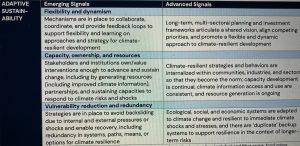
The case studies evaluated outcome(s) ex-post, including the levels of specific outcomes and impact(s) at ex-post compared to the final project evaluation.They identified which drivers of sustainability (e.g., ownership, resources, partnerships, capacities) contributed to existing and emerging outcomes (what emerged from local efforts to sustain results differently ex-post). Findings are organized based on what was positive and what was negative, as well as what unexpected results or instances of maladaptation were observed ex-post. The teams looked for Emerging vs Advanced Transformation Signals across: a) Flexibility and dynamism, b) Capacity, ownership, and resources, and c) Vulnerability reduction and redundancy.
Some of the high-level lessons across all the PPCR projects regarding adaptive sustainability were:
1) High local ownership has contributed to most PPCR-supported infrastructure and natural assets still being operational, and agricultural practices continuing
2) Project outcomes have been sustained so far, though this is unlikely to last many more years.
3) Some unintended distributional justice issues arose after project completion, with vulnerable groups not experiencing the same lasting benefits as other stakeholders
4) There is limited evidence of follow-up or ongoing monitoring after project completion, representing a lost learning opportunity.
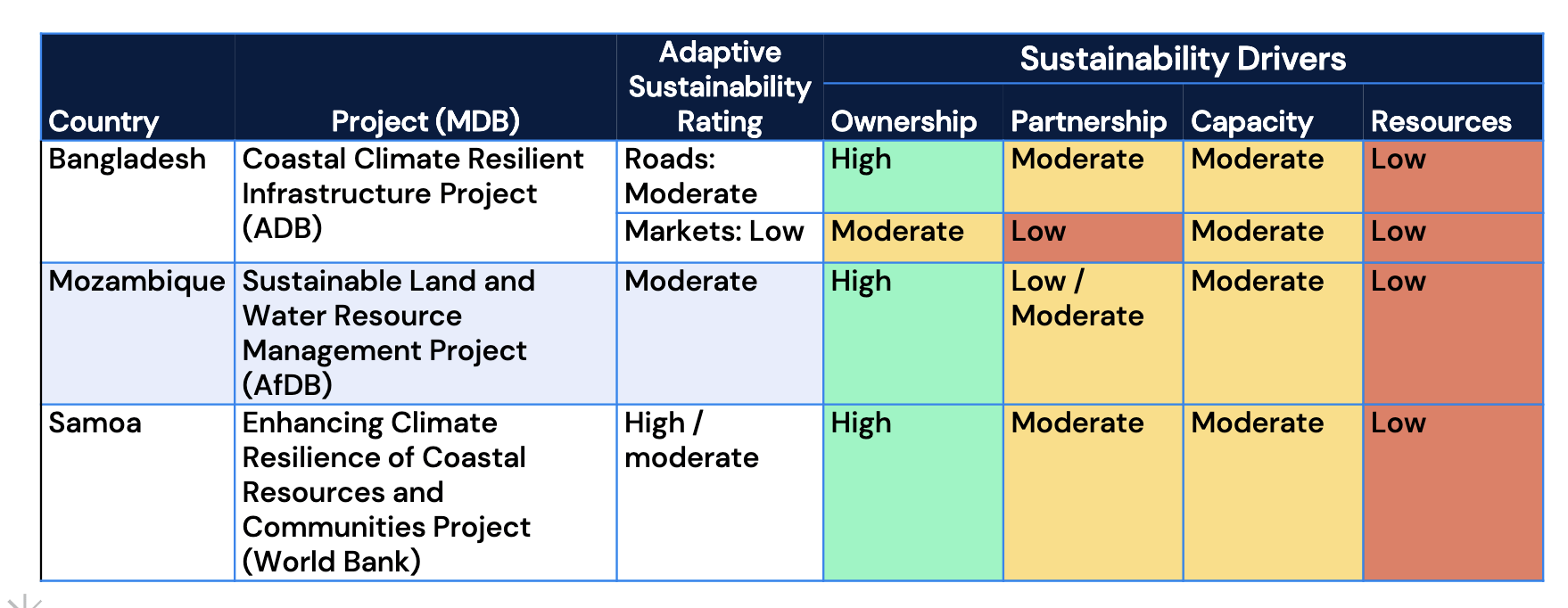
All three ex-post detailed cases’ adaptive sustainability results were mixed.Table 2 below shows Ownership, followed by Capacity, and Partnerships being moderate, and Resources to sustain results being weaker drivers of adaptive sustainability. Therefore planning for ongoing resources to sustain operations and maintenance of assets is a clear lesson.
In the fieldwork, some elements continued to be sustained, mainly due to local ownership and other resilience sources (see the Samoan pool below). “There are multiple backup systems in place. Village governance structures, along with rehabilitated pools, provide redundancy and alternative water sources in case of government water supply disruptions due to climate events.”
Several assets faltered due to a lack of sufficient ongoing operations and maintenance while other assets disappeared or held on. One Bangladesh market stall sank months after construction, in part due to climate shocks and in part to insufficient design for resilience, while other assets, such as roads, withstood years of cyclones thanks to local maintenance:
In Mozambique, more farming irrigation assets were sustained than failed in the face of management design and climate stresses, but ownership was the driver to ensure continuation.At one site, a lack of resources, capacities, and partnerships limited success; however, the local farmers’ determination found additional resilience resources to compensate for irrigation issues, utilizing a natural spring and reverting to manual watering.
Across the cases, local ownership is the primary driver; however, resources are still needed. The CIF found the lessons to be very illuminating and is incorporating them into future programming. Let us know how you can use these lessons as well…
How will we be new this New Year? It may seem funny as an ex-post sustainability evaluator to write about the future rather than the past :). But ex-post learning is learning from past successes or failures for future improvements. Such learning is part of “longtermism”where “positively influencing the long-term future is a key moral priority of our time. It’s about taking the sheer scale of the future seriously, and how high the stakes might be in shaping it” (which for many of us means learning from the past to do better in the future). “It means thinking about the challenges we might face in our lifetimes that could impact civilisation’s whole trajectory, and taking action to benefit not just the present generation, but all generations to come…. Many social movements have fought for greater recognition for disempowered members of society. Advocates of longtermism want to extend this recognition to future people, too.”
Taking the longer view also means taking a global view and continuing to address the disparities that our economic system generates, and seems to be generating more destructively. As Oxfam’s excellent Inequality annual reporttells us, “since 2020, the richest five men in the world have doubled their fortunes. During the same period, almost five billion people globally have become poorer.” At the same time, the UN cites a World Bank estimate that an additional 68 to 135 million people could be pushed into poverty by 2030 because of climate change”. Given the EU is 450 million and US is 330 million, imagine 20-30% of our populations falling into poverty due to changes we can make – but did not – in addressing inequality and a sustainable, liveable planet. I don’t know what your long-term vision for y/our world is, but I’m quite sure adding to global poverty is not on the list.
What can we do anew?
Where life is stable: Focus on our collective communities and our planet and helping others: the NYTimes on making new year’s resolutions for collective happiness. I would add, we need to make choices from a planetary perspective – I got a plug-in electric hybrid Toyota CHR this year so I would pollute less and am a vegetarian (aspiring vegan) to decrease my tiny share of the 30% of emissions due to our food systems. Am reading the book The Logic of Sufficiency and preparing to read Less is More will help us consume less, as we need less. Remember, as we in the Global North consume less, the Global South is likely to suffer less, as they have caused so little of today’s climate crisis.Generation Climate Europe states: “In 2019, the top 10% of global emitters (771 million individuals) were responsible for about 48% of global CO2 emissions, while the bottom 50% (3.8 billion individuals) were responsible for almost 12% of all emissions.” This is a staggering statistic we all need to act to reverse.
Take a longer view, doing ex-post evaluations, for sectors such as agriculture, even for disasters: 3ie admitted that only 4% of all impact evaluations include long-term learning about food systems interventions evaluating long-term outcomes (including climate change) and a collection of sustainability learning byIDEV’s Sustainability Matters asks us to take a holistic approach, covering the full spectrum of environmental, social and economic sustainability. Both sources tell us we need to do more evaluation and learning over the longer-term as climate shocks increase. Disaster Science also discusses the need for a longer-term view – this means putting out fires but thinking longer-term (see longtermism above :)) about how we can make our interventions more sustained. We can ‘bake-in’ or ‘hardwire” sustainability as we shared here in a VV blog about health projects. Also this includes evaluating climate adaptation ex-post as the Adaptation Fund has shared (and I spoke at the European Evaluation Society Conference) positive and negative lessons from our ex-post learning from past design/ implementation for future sustainability. Proud that the Fund has created the Adaptation Fund’s toolkit, and in 2025, look for more ex-post learning from the Climate Investment Funds and other clients!
EES Conference presentation – Rimini in 2024 (photo by the Vladislav Arnaoudov)
Use our money to do more measurable good: pushing the private sector for more equitable investments given public funds to do good are so stretched: Dr G. Marcellenotes that we need transformative sustainable finance (which is environmental, social, and governance (ESG)) to address inequalities and address climate change harm being done. As an evaluator, we need to measure real impactas the Adaptation and Resilience Investors’ Cooperative does or the Global Impact Investor Network (GIIN) which has set up benchmarks in Agriculture, Forestry, Energy, and Finance. And we so need mandatory, transparent and comprehensive reportingwhich fosters trust, not greenwashing or wishful thinking. Also considerwhat banks you are funding, some profit from more fossil fuels.
Appreciate and learn from what works and do more of it, patiently, especially at the community level! This BBC article celebrates 5 successes against biodiveristy loss. This Barbados conference“Sustainable Energy for Equity, Security and Prosperity” I will attend in 2025 (!) may also cover the exciting new debt for climate resilience dealwhich is the world’s first! IDEVreminds us conservation is most powreful at the community level, but we must learn from monitoring data, locally. IFAD reminds us sustained development takes time and resources and patience.
Grow the .002% of all global development projects that are evaluated ex-post closure for sustainability
It seems like ‘fake news’ that after decades of global development so few evaluations would have peered back in time to see what was sustained. While I was consulting to the Policy Planning and Learning Bureau at USAID, I asked the head of this M&E department who does ex-post sustainability evaluation as I knew USAID had done some in the 1980s, Cindy Clapp-Wincek answered ‘No one, there are no incentives to do it.’ (She later became our advisor.)
Disbelieving, I did a year of secondary keyword research before devoting my professional consulting life to advocating for and doing ex-post evaluations of sustained outcomes and impacts. I searched USAID, OECD, and other bilateral and later multilateral donors’ databases and found thousands of studies, most of which were inaccurately named ‘ex-post’ or ‘post-closure’ studies. Some of the roughly 1,000 projects I looked at at USAID and OECD that came up under ‘ex-post’, ‘ex post’, ‘post closure’ were final evaluations that were slightly delayed, a few were evaluations that were at least one year after closure, but were desk studies without interviews. Surprisingly, the vast majority of final evaluations found were those that only recommended ex-post evaluation several years later to confirm projected sustainability.
Of 900+ “ex-post” “ex post” “post closure” documents in USAID’s DEC database, there were only 12 actual post-project evaluations with fieldwork have been done in the last 20 years
Of 12,000 World Bank projects – only 33 post-project evaluations asked ‘stakeholders’ for input, and only 3 showed clearly they talked to participants
In 2010 Asian Development Bank conducted 491 desk reviews of completed projects, and returned to 18 actual field-based post-project evaluations that included participant voices; they have done only this 1 study.
We found no evaluations by recipient governments of aid projects’ sustainability
12 years of research, advocacy and fieldwork later, the ‘catalysts’ database on Valuing Voices now shows actual fieldwork-informed evaluations by 40 organizations that had actual ex-posts that returned to the field to ask participants and project partners what was sustained, highlighting 92 ex-posts.
Ten were multilaterals, international and UN organizations (e.g. World Bank including the Adaptation Fund, OECD, ADB but no IADB or African Development Bank)
14 were bilaterals (USAID, GTZ, only a handful from the Nordics and the Netherlands where we did a deep dive into five countries that claimed 32 ex-posts but have only done 16), one from the UK, and surprisingly none were found from France Development, Canada’s CIDA/ Global Affairs, Sweden or Denmark’s governments)
Notably, JICA is the superstar learning organization in ex-post evaluation, having done more than 2.500 evaluations since 1993 exploring ‘sustained net benefits over time’ of their grants, loans, and technical cooperation. They return three years post-closure and sometimes again seven years post-closure, an amazing feat. Whether their projects are more sustained, as a result is an unanswered question, but at least it’s more likely given they’re learning what worked locally after they went home, what did not, and why and whether their suggested remedies after 3 years were carried out (which they check 7 years post closure).
How many ex-post project closure evaluations have been done? .002% of all projects. The 0.002% statistic looks at just public foreign development aid from 1960 (not even counting private funding such as foundations or gifts to organizations, which isn’t tracked in any publicly available database). Calculating aggregated OECD aid statistics (excluding private because it’s only recent data) over 62 years $5.6 trillion by 2022 (thanks to Rebecca Regan-Sachs for the updated #s).
I then estimated 3.000 actual ex-posts which comes from 2,500 JICA projects plus almost 500 other projects that I have either found looking through databases all across the spectrum from governments and multilaterals (almost 100 in our catalysts, and am assuming there must be 400 others done in the 1980s-2000 like USAID and the World Bank).
Without a huge research team it is improssible to aggregate data on the total number of projects by all donors. So I extrapolated from project activity disbursements of one year (2022) for Mali on the www.foreignassistance.gov page. In my 35 years of experience, Mali, where I did my doctoral research, typifies he average USAID aid recipient. They had 382 projects going in 2022. I rounded up to 400 projects x 70 years (since 1960 when OECD data began) x 100 countries by just one donor (of the 150 possible recipient countries, to be conservative). This comes to 2.8 million projects. So if we take 39 OECD countries as donors (given most have far less to give than US), in total 109 million publicly funded aid projects disbursed $5.6 trillion since 1960. While final evaluations are industry standard, only .002% is the estimated number of ex-post evaluations of projects the were evaluated with data from local participants and partners of the 109 million projects .
This became Valuing Voices focus, and we created an open-access database for learning, and conducted our own My team and I identified 92 ex-posts that returned to ask locals what lasted, what didn’t, why, and what emerged from their own efforts. We also created evaluability checklists and created a new evaluation, Sustained and Emerging Impacts Evaluation that included examining not just what donors put in place to last, but also what emerged outcomes from local efforts to sustain results with more limited resources, partnerships, capacities and local ownership/motivation. These four drivers were found by Rogers and Coates for USAID’s food security exit study in 2015). We have done 15 ex-posts for 9 clients since 2006 and shared Adaptation Fund ex-post training materials in 2023.
Yet the public assumes we know our development is sustainable. 2015’s ‘Sustainable Development Goals‘ focused aid on 17 themes, which was to generate $12 trillion more in annual spending on SDG sectors than the;$21 trillion already being invested each year. Nonetheless, a recent UN report states that there is now a $4 trillion annual financing gap to achieve the SDGs. All this funding goes to projects that are currently implemented, not to evaluate what had been sustained from past projects that already closed. Such learning from what succeeded or failed, or what emerged from local efforts to keep activities and results going is pivotal to improving current and future programming is almost wholly missing from the dialogue; I know, I asked multiple SDG evaluation experts.
Why do we return to learn so rarely? There are many reasons, the most prosaic among them being administrative.
When aid funds are spent over 2-10 years, projects are closed, evaluated at the end, ‘handed over’ to national governments, and no additional funding exists to return ‘ex-post’ closure to learn.
Next is the push to continue to improve lives through implementation which means low rates of overhead allocated to M&E and learning during, much less after closure.
Another is the assumption that ‘old’ projects differ so much from new ones, but there are few differences. After all there are only so many ways to grow food, feed the malnourished, educate children; evaluating ‘old’ projects can teach ‘new’ projects.
A last major one, from Valuing Voices’ research of 12 years may be the largest: Fear of admitting failure. Please read Valuing Voices’ 2016 blog highlighted many Lessons about Funding, Assumptions and Fears (Part 3). One US aid lobbyist told me in 2017 that I must not share this lack of learning about sustained impacts because it could imperil US aid funding; I told her I had to tell people because lives were at stake.
Overall, there is much to learn; most ex-post evaluations show mixed results. None show 100% sustainability and while most show 30-60% sustainability, none are 0% sustained either. If we don’t learn to replicate what worked and cease what didn’t now, then future programming will be as flawed and successes, especially brilliant emerging locally designed ex-post outcomes such as Niger’s local funding of redesign of health incentives will remain hidden.
Occasionally donors invest in sets of ex-post learning evaluations such as USAID’s ‘global waters’ seven water/ sanitation evaluations linked to the E3 Bureau taking sustainability as a strategic goal. Yet the overall findings from USAID’s own staff of these ex-posts Drivers of WASH study were chilling. While 25 million gained access to drinking water and 18 million to basic sanitation, ‘they have largely not endured.’ But the good news in such research is that the donor learned that infrastructure fails when spare parts are not accessible and maintenance not funded or performed, which can be planned for and addressed during implementation by investing in resources and partnerships. They learned that relying on volunteers is unreliable and management needs to be bolstered, which can lead to some implementation funding to be focused on capacities and local ownership. We can plan better for sustainability by learning from ex-post and exit studies (see Valuing Voices’ checklists in this 2023 article on Fostering Values-Driven Sustainability).
And since 2019, three climate funds, the Adaptation Fund, the Global Environmental Facility, and the Climate Investment Funds have turned to ex-post evaluations to look at sustainability and longer-term resilience and even transformation, given environmental shocks may take years to affect the project sites. The Adaptation Fund has done four ex-posts, with more to come in 2024/25, and the CIF is beginning now. The GEF has done a Post-Completion Assessment Pilot for the Yellow Sea Region . Hopeful!
Following on from the localization blog by PLAN, APEA has shared why trust is declining in local communities. Note the learn not give lesson 🙂
Reblog of Asia Pacific Evaluation Association apea-admin/ Rituu Nanda: https://asiapacificeval.org/trust-is-both-a-belief-and-a-bond/
Trust is both a belief and a bond: Why is Trust for outsiders declining in communities? (Insights from 13 countries across four continents)
.
A group of 16 Participants of the Community Ownership in MEL and Research Group of APEA from Benin, Bangladesh, France, India, Indonesia, Nepal, Nigeria, New Zealand, Nigeria, Pakistan, Sri Lanka, Tunis, UK came together on 15th March’24 to discuss issues around Trust. (Ahmed, Amol Shaila Suresh, Anita Cheria, Bhuban Bajracharya, Chinenye Mercy Morka, Fiona Cram, Jhank, Lipika Das Gupta, Luc Barrière-Constantin, Maroof, Pakeeza Arif, Randika De Mel, Rituu B Nanda, Sarah Gharbi, Sushila Pandit, Visvalingam Muralithas.)
(This post is compiled by Rituu B Nanda based on the inputs of the discussion)
.
.
Trust is a basic need It helps anyone survive, and maintain relationships including with self, immediate family members, society. Trust helps in connecting one with others and just being yourself.
.
What do we mean by trust?
The absence of doubt about other’s intention…
Being transparent and acknowledging that we know less about them, and seek to build understanding.
Recognizing that our actions may only play a small role in people’s lives and approaching with a sense of modesty and humility.
Standing with the communities, being one of them.
Convince the communities about our sincere intentions
Trust is about visiting with people
.
Decline in trust-internal and external
We observe a loss of trust both towards outsiders and within the communities themselves. Communities are losing trust in the system, implementation agencies, evaluation professionals and researchers. Due to longstanding practices followed by outsiders, the younger generation exhibits less trust in them compared to older generations, as their expectations remain unfulfilled. Moreover, trust within communities has eroded not only within groups in communities and neighbourhoods but also amongst family members.
.
Why is community’s Trust eroding in outsiders?
Evaluators’ approach is often perceived as overly theoretical by communities. Community members feel that stakeholders treat them merely as means to achieve their own agenda. Outsiders, driven by predefined targets, tend to impose objectives on communities, exacerbating mistrust.
Tribal or indigenous communities prefer isolation and often resist mainstreaming efforts , feeling unheard and excluded from decision-making processes that affect them.
Repeated service delivery projects in communities foster dependency rather than empowerment. Additionally, implementation agencies lack transparency and come with pre-planned projects without involving community in design.
The decline in trust is compounded by a sense of fatigue, as projects often address surface-level issues without tackling systemic problems. Consequently, expectations remain unmet, fuelling disillusionment among community members.
Communities express frustration with organizations that promise resources but vanish after a few years, leaving behind unfulfilled promises. This perpetuates the erosion of trust in development professionals.
Example from north Sri Lanka: Post-war Reconciliation A range of complex challenges can affect the well-being and social cohesion of residents. The northern part of Sri Lanka has been deeply affected by the decades-long civil conflict, and issues of reconciliation between different ethnic and religious groups remain. Rebuilding trust and fostering dialogue among communities is essential for long-term peace and stability.
.
How can we restore Trust?
Government authorities, civil society organizations, local communities, and other stakeholders have to prioritize inclusive development, social cohesion, and respect for diversity to build trust:
Trust is fragile and rather than imposing external definition, we need to understand how communities define trustthemselves.
Mistrust within a community often stems from past episodes, usually rooted in bitter experiences. It is the responsibility of outsiders to delve into these causes and initiate the rebuilding process.
Without trust from the community, a project is likely to fail. So, engagement with communities must commence with trust-building.
Cultivate competent communities which can address certain issues independently. For example, in rural Nepal, where a small percentage of households face extreme poverty, local government and communities can collaborate to address their needs.
Transparency regarding project objectives is paramount. Instead of devising plans and then presenting them to the community, they should be involved in shaping the work plan from the start.
“Outsiders need to come to learn, not to give” – We need to be learners ourselves. If we position ourselves solely as experts, communities may be less inclined to engage with us. Knowledge exchange should flow both ways. Building trust necessitates authenticity and genuine connections. To restore trust – we have to be non-judgemental, by being ourselves
Consistency is fundamental in trust-building. Move away from short term funding. Long-term engagement demonstrates commitment, gradually fostering trust over time.
.
Rebuilding Trust-from deficit based to strength-based approach After the Ebola epidemic, Constellation was invited to Guinea and Liberia to rebuild trust in communities toward government health services. Employing the SALT approach, communities took ownership and initiated dialogue with health officials, thereby strengthening trust and partnership between both stakeholders. https://the-constellation.org/opening-safe-conversations-to-restore-trust-after-ebola/
.
Conclusion Participants agreed that trust is fundamental for survival, and therefore, growing mistrust is worrying as the world becomes increasingly fragmented. Trustworthy relationships are crucial for sustaining long-term partnerships and ensuring the effectiveness of evaluations. Through trust, we can foster a safe environment for ourselves and others.
Jindra Cekan, Ph.D. has used participatory methods for 30 years to connect with participants, ranging from villagers in Africa, Central/ Latin America and the Balkans to policy makers and Ministers around the world for her international clients. Their voices have informed the new Sustained and Emerging Impacts Evaluation, other M&E, stakeholder analysis, strategic planning, knowledge management and organizational learning.
If you don’t find what you are looking for via the search, categories, or posts above, you can go to the Blog page, scroll to the bottom, and click “previous posts” to go through all of the posts (newest–>oldest).
Cookie Consent
We use cookies to improve your experience on our site. By using our site, you consent to cookies.
ID used to identify users for 24 hours after last activity
24 hours
_gat
Used to monitor number of Google Analytics server requests when using Google Tag Manager
1 minute
_gac_
Contains information related to marketing campaigns of the user. These are shared with Google AdWords / Google Ads when the Google Ads and Google Analytics accounts are linked together.
90 days
__utma
ID used to identify users and sessions
2 years after last activity
__utmt
Used to monitor number of Google Analytics server requests
10 minutes
__utmb
Used to distinguish new sessions and visits. This cookie is set when the GA.js javascript library is loaded and there is no existing __utmb cookie. The cookie is updated every time data is sent to the Google Analytics server.
30 minutes after last activity
__utmc
Used only with old Urchin versions of Google Analytics and not with GA.js. Was used to distinguish between new sessions and visits at the end of a session.
End of session (browser)
__utmz
Contains information about the traffic source or campaign that directed user to the website. The cookie is set when the GA.js javascript is loaded and updated when data is sent to the Google Anaytics server
6 months after last activity
__utmv
Contains custom information set by the web developer via the _setCustomVar method in Google Analytics. This cookie is updated every time new data is sent to the Google Analytics server.
2 years after last activity
__utmx
Used to determine whether a user is included in an A / B or Multivariate test.
18 months
_ga
ID used to identify users
2 years
_gali
Used by Google Analytics to determine which links on a page are being clicked

 The EU writes, “Ecosystems services offer benefits such as the pollination of crops, clean air, a reduction in extreme weather, human mental and physical well-being, wood for construction, fossil fuels, fresh water, tourism, science, education, recycling, fertilizer, carbon capture, outdoor sports, lakes, flood protection, hydroelectric power, and decomposition of wastes. It’s hard to put a value on every way that rocks, forests, beaches, woods, plants and animals help our lives. But we can put an economic value on the combined benefits of the world’s ecosystems.”