Continuing to Learn about Sustainability, Now more than ever
Since 2024, foreign aid has taken multiple shocks (post-Covid): wars, climate shocks, and a widespread retreat from foreign assistance, especially among OECD countries: “Official development assistance (ODA) by Development Assistance Committee (DAC) members and associates amounted to USD 174.3 billion in 2025, a 23.1% decrease over 2024. It is the largest annual contraction on record and a second consecutive year of decline, bringing ODA to where it stood at the start of the 2030 Agenda for Sustainable Development.” Notably, many of these cuts were bilateral donations, notably from the USA, Germany, France, Japan, and the UK. Least developed countries and sub-Saharan Africa. A striking statistic cited by the US Council on Foreign Relations was that by 2025, Americans collectively spent more on their Halloween candy ($3.9B) than their government did on life-saving humanitarian aid ($3.4B).” However, they excluded in-donor refugee costs, humanitarian aid and debt relief, and while USAID was dismantled in early 2025, a bit of health funding has been restored. Still, 72% of the UN’s funding needs are unmet, unparalleled, which includes 25 million fewer people received aid in 2025, such as those with rising needs in Gaza, Sudan, Iran, Haiti, Yemen, and Ukraine’s wars not to mention rising natural catastrophes from floods and fires raging currently in 2026’s El Niño.
In mid-2026, OXFAM reported that “aid’s crucial role in combating diseases like HIV-AIDS and malaria, the Institute of Global Health of Barcelona estimated that global aid cuts of such magnitude would kill hundreds of thousands of people in 2025 alone. If this trend continues, aid cuts could kill over 9 million people by 2030” while Rockefeller Foundation cites Lancet projections that “aid cuts could lead to more than 22 million avoidable deaths by 2030, including 5.4 million children under five, according to the most comprehensive modelling to date.” (Oxfam pointedly notes that “top 0.1 percent richest people worldwide hide $2.84 trillion in tax havens. Even a small tax on that wealth would yield much more than the amount of aid cuts,” but political will is needed for that, in a world led by elites, thus unlikely.)
So this is bad, as according to a 2026 poll that found that 46% of African youth believed the “closure of USAID would have a damaging impact on their countries, with healthcare services and disease prevention seen as the areas most affected.” Yet a quarter of African youth, believed USAID cuts were positive, as they want their governments “to take agency and responsibility for their own reality” and stop being influenced by foreign powers. Further, “A lot of people find aid very demeaning…“they didn’t feel that the aid was being used for the right things and there is a sense of ‘We can do this for ourselves’.”
This gives us several learning opportunities, in addition to re-examining why the messages about the need for and effectiveness of aid were not heard.
1) We would ground-truth the modelling and confirm the projected negative effects as well as document the unintended positive effects of these aid cuts in terms of how communities coped This is because most sustained results documented by our SEIE (Sustained and Emerging Impacts Evaluation) and other ex-post evaluation show that national uptake and continuation is key to results lasting as we documented in five cases in Part 1:What Happens After the Project Ends? driven by Country-national Ownership in Part 2.
2) We would also continue to evaluate the sustainability of results, as Japan’s JICA, which performs ex-post evaluations in addition to “terminal evaluations” and “post-project monitoring” several times post-closure for rich design learning. They have done 3,000 such evaluations and are a continued leader in this field, most recently highlighted in this recent annual report on lessons for Technical Cooperation, ODA Loans and Grant Aid, which showed they did 66 ex-post evaluations for Technical Cooperation, 24 for ODA Loans, and 26 for Grant Aid. Of the projects that do remain, the need is even more vital to show sustainability results to combat more aid cuts on the supposed lack of effective – and defensible- results.
3) What can be done immediately for all projects that are currently underway is to embed learning about projected sustainability by planning for it. This involves by using checklists from at least the mid-point onward that create the conditions for sustainability, as well as consider needed commitments to sustainability and revise implementation pre-closure. Authors from Central Asia and Asia share insights about the need for continued knowledge from such evaluations, below.
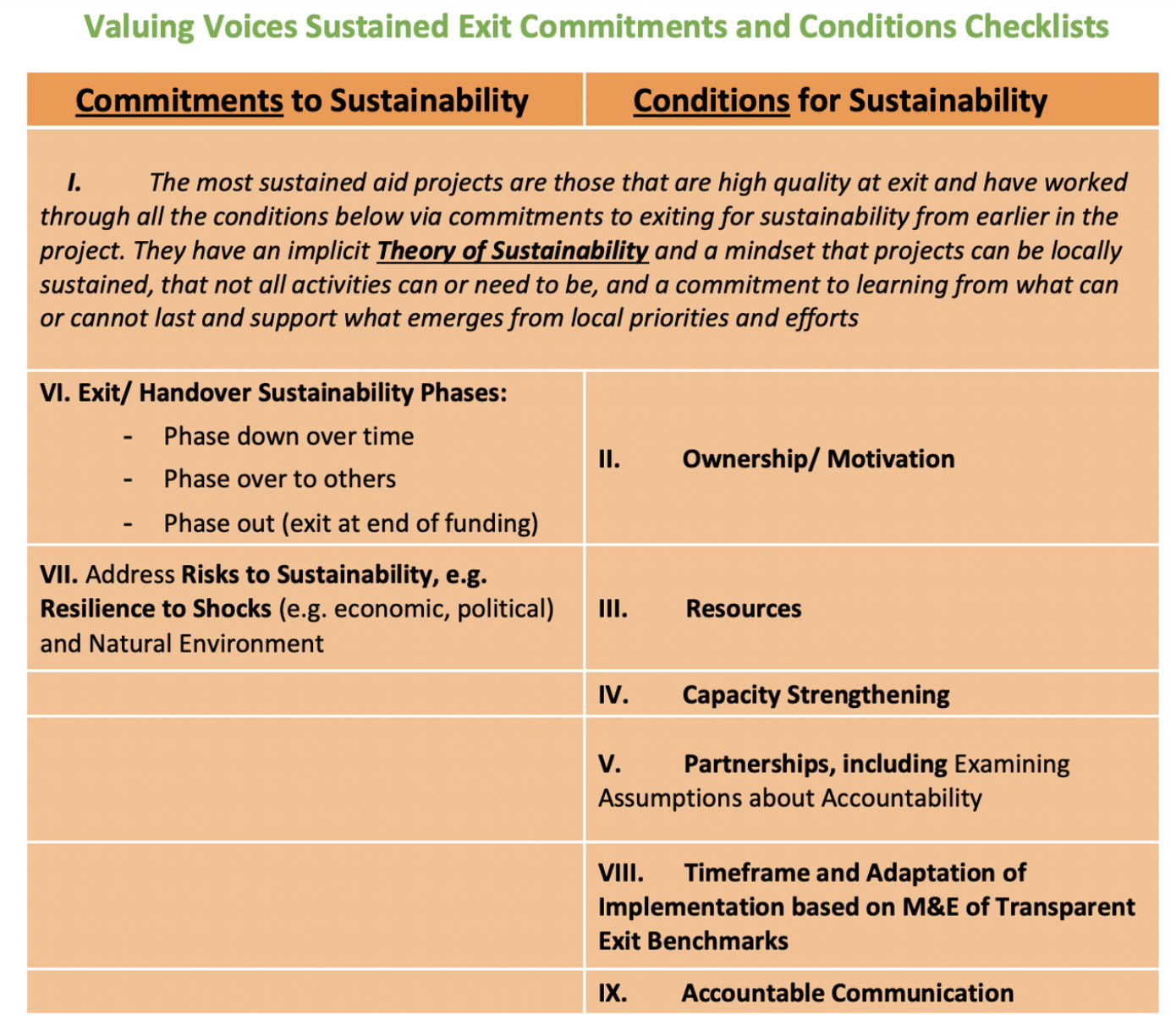
This table comes from 9 checklists cited in the following work we did on capacity development and lessons pre-exit and ex-post closure: http://www.valuingvoices.com/fostering-values-driven-sustainability-through-an-ex-post-capacities-lens-reposting-a-book-chapter/. Please note the increasing need to evaluate the ecological systems in which development and humanitarian projects are embedded.
The blog posts above noting the need to embed resilience and institutional pathways during the crisis itself, as well as excellent pages from Muhammad Maksudul Hannan from Bangladesh noting the need to retain knowledge locally and how we should be measuring behavior change rather than trainings done, show how, overall, to do good monitoring, evaluation, and learning (MEL). This continues to be true for the remaining 77% of aid programming that continues to assist ‘development’, as well as the many corporates launching projects in LDCs such as for community-level carbon credits which are equally in need of MEL.
A recent Better Evaluation post on whether evaluating sustainability in humanitarian contexts matters amid shrinking budgets and hyper-prioritization; “whether today’s investments yield benefits that endure and whether responses help build systems and capacities that can last.” Examples from Central Asia and Afghanistan show the need to localize evaluation to the context, but that it is still sorely needed, pre-exit and post to “provide evidence on humanitarian interventions’ lasting contributions.”
4) For those restructuring foreign aid (USA especially): The ex-post sustainability learning shows that when donors design and implementation by putting ownership in local communities from the start in true partnership, take sufficient time to implement (up to 10 years, not 1 or 2), put in feedback loops and act on their input by revising implementation to support capacities to maintain assets and pass on knowledge to non-participants, have sufficient resources generated to pay for ongoing costs and expand livelihoods in emerging ways to be resilient to new shocks (and opportunities!) in their ecological contexts, sustainability and greater resilience will follow.
Let me know your thoughts during this turbulent time…

31 years of Valuing Voices of national participants, project partners, donors and technical staff. Let’s have sustained impact!