by Jindra Cekan | Dec 31, 2024 | 3ie, Accountability, Adaptation Fund, blended finance, climate change, environment, ESG, European Evaluation Society (EES), European Union, Evaluation, ex post evaluation, ex-post evaluation, foreign aid, GIIN, IDEV, Impact, impact investing, international development, Localization, longtermism, Monitoring and Evaluation, OXFAM, Participants, post project evaluation, Private sector, Sustainability, Sustainable Finance
NEW YEAR, NEW SUSTAINABLE US?
Happy 2025!

(Image from: https://plumvillage.org/articles/can-the-new-year-really-be-new)
How will we be new this New Year? It may seem funny as an ex-post sustainability evaluator to write about the future rather than the past :). But ex-post learning is learning from past successes or failures for future improvements. Such learning is part of “longtermism” where “positively influencing the long-term future is a key moral priority of our time. It’s about taking the sheer scale of the future seriously, and how high the stakes might be in shaping it” (which for many of us means learning from the past to do better in the future). “It means thinking about the challenges we might face in our lifetimes that could impact civilisation’s whole trajectory, and taking action to benefit not just the present generation, but all generations to come…. Many social movements have fought for greater recognition for disempowered members of society. Advocates of longtermism want to extend this recognition to future people, too.”
Taking the longer view also means taking a global view and continuing to address the disparities that our economic system generates, and seems to be generating more destructively. As Oxfam’s excellent Inequality annual report tells us, “since 2020, the richest five men in the world have doubled their fortunes. During the same period, almost five billion people globally have become poorer.” At the same time, the UN cites a World Bank estimate that an additional 68 to 135 million people could be pushed into poverty by 2030 because of climate change”. Given the EU is 450 million and US is 330 million, imagine 20-30% of our populations falling into poverty due to changes we can make – but did not – in addressing inequality and a sustainable, liveable planet. I don’t know what your long-term vision for y/our world is, but I’m quite sure adding to global poverty is not on the list.
What can we do anew?
- Where life is stable: Focus on our collective communities and our planet and helping others: the NYTimes on making new year’s resolutions for collective happiness. I would add, we need to make choices from a planetary perspective – I got a plug-in electric hybrid Toyota CHR this year so I would pollute less and am a vegetarian (aspiring vegan) to decrease my tiny share of the 30% of emissions due to our food systems. Am reading the book The Logic of Sufficiency and preparing to read Less is More will help us consume less, as we need less. Remember, as we in the Global North consume less, the Global South is likely to suffer less, as they have caused so little of today’s climate crisis. Generation Climate Europe states: “In 2019, the top 10% of global emitters (771 million individuals) were responsible for about 48% of global CO2 emissions, while the bottom 50% (3.8 billion individuals) were responsible for almost 12% of all emissions.” This is a staggering statistic we all need to act to reverse.
- Take a longer view, doing ex-post evaluations, for sectors such as agriculture, even for disasters: 3ie admitted that only 4% of all impact evaluations include long-term learning about food systems interventions evaluating long-term outcomes (including climate change) and a collection of sustainability learning by IDEV’s Sustainability Matters asks us to take a holistic approach, covering the full spectrum of environmental, social and economic sustainability. Both sources tell us we need to do more evaluation and learning over the longer-term as climate shocks increase. Disaster Science also discusses the need for a longer-term view – this means putting out fires but thinking longer-term (see longtermism above :)) about how we can make our interventions more sustained. We can ‘bake-in’ or ‘hardwire” sustainability as we shared here in a VV blog about health projects. Also this includes evaluating climate adaptation ex-post as the Adaptation Fund has shared (and I spoke at the European Evaluation Society Conference) positive and negative lessons from our ex-post learning from past design/ implementation for future sustainability. Proud that the Fund has created the Adaptation Fund’s toolkit, and in 2025, look for more ex-post learning from the Climate Investment Funds and other clients!

EES Conference presentation – Rimini in 2024 (photo by the Vladislav Arnaoudov)
- Use our money to do more measurable good: pushing the private sector for more equitable investments given public funds to do good are so stretched: Dr G. Marcelle notes that we need transformative sustainable finance (which is environmental, social, and governance (ESG)) to address inequalities and address climate change harm being done. As an evaluator, we need to measure real impact as the Adaptation and Resilience Investors’ Cooperative does or the Global Impact Investor Network (GIIN) which has set up benchmarks in Agriculture, Forestry, Energy, and Finance. And we so need mandatory, transparent and comprehensive reporting which fosters trust, not greenwashing or wishful thinking. Also consider what banks you are funding, some profit from more fossil fuels.
- Appreciate and learn from what works and do more of it, patiently, especially at the community level! This BBC article celebrates 5 successes against biodiveristy loss. This Barbados conference “Sustainable Energy for Equity, Security and Prosperity” I will attend in 2025 (!) may also cover the exciting new debt for climate resilience deal which is the world’s first! IDEV reminds us conservation is most powreful at the community level, but we must learn from monitoring data, locally. IFAD reminds us sustained development takes time and resources and patience.
- What else would you add?
Happy Sustainable New Year, New Us!
by Jindra Cekan | May 16, 2024 | 3ie, Accountability, Adaptation Fund, Aid effectiveness, American Evaluation Association (AEA), Better Evaluation, Catholic Relief Services (CRS), Donors, Evaluation, ex post evaluation, ex-post evaluation, locally-led development, OECD, Participants, post project evaluation, post-project evaluation, SEIE, Sustainability, Sustainable development, Sustained and Emerging Impacts Evaluation
Grow the .002% of all global development projects that are evaluated ex-post closure for sustainability
It seems like ‘fake news’ that after decades of global development so few evaluations would have peered back in time to see what was sustained. While I was consulting to the Policy Planning and Learning Bureau at USAID, I asked the head of this M&E department who does ex-post sustainability evaluation as I knew USAID had done some in the 1980s, Cindy Clapp-Wincek answered ‘No one, there are no incentives to do it.’ (She later became our advisor.)
Disbelieving, I did a year of secondary keyword research before devoting my professional consulting life to advocating for and doing ex-post evaluations of sustained outcomes and impacts. I searched USAID, OECD, and other bilateral and later multilateral donors’ databases and found thousands of studies, most of which were inaccurately named ‘ex-post’ or ‘post-closure’ studies. Some of the roughly 1,000 projects I looked at at USAID and OECD that came up under ‘ex-post’, ‘ex post’, ‘post closure’ were final evaluations that were slightly delayed, a few were evaluations that were at least one year after closure, but were desk studies without interviews. Surprisingly, the vast majority of final evaluations found were those that only recommended ex-post evaluation several years later to confirm projected sustainability.

In 2016 at the American Evaluation Association conference, a group of us did a presentation. In it, I cited these statistics from of 1st year of Valuing Voices’ research:
- Of 900+ “ex-post” “ex post” “post closure” documents in USAID’s DEC database, there were only 12 actual post-project evaluations with fieldwork have been done in the last 20 years
- Of 12,000 World Bank projects – only 33 post-project evaluations asked ‘stakeholders’ for input, and only 3 showed clearly they talked to participants
- In 2010 Asian Development Bank conducted 491 desk reviews of completed projects, and returned to 18 actual field-based post-project evaluations that included participant voices; they have done only this 1 study.
- We found no evaluations by recipient governments of aid projects’ sustainability
12 years of research, advocacy and fieldwork later, the ‘catalysts’ database on Valuing Voices now shows actual fieldwork-informed evaluations by 40 organizations that had actual ex-posts that returned to the field to ask participants and project partners what was sustained, highlighting 92 ex-posts.
- Ten were multilaterals, international and UN organizations (e.g. World Bank including the Adaptation Fund, OECD, ADB but no IADB or African Development Bank)
- 14 were bilaterals (USAID, GTZ, only a handful from the Nordics and the Netherlands where we did a deep dive into five countries that claimed 32 ex-posts but have only done 16), one from the UK, and surprisingly none were found from France Development, Canada’s CIDA/ Global Affairs, Sweden or Denmark’s governments)
- 16 were non-profits. Notably in the industry, many point to the World Bank as the leader, but after meeting the head of M&E at the IEG in 2015, most have shown to be internal studies, and desk studies or, worse World Bank’s GEF used projected sustainability estimates and claimed actual sustainability of results.
- Notably, JICA is the superstar learning organization in ex-post evaluation, having done more than 2.500 evaluations since 1993 exploring ‘sustained net benefits over time’ of their grants, loans, and technical cooperation. They return three years post-closure and sometimes again seven years post-closure, an amazing feat. Whether their projects are more sustained, as a result is an unanswered question, but at least it’s more likely given they’re learning what worked locally after they went home, what did not, and why and whether their suggested remedies after 3 years were carried out (which they check 7 years post closure).
- Famed evaluator Michael Scriven’s Faster Forward Fund gave us a grant to evaluate eight ex-posts and share methodological highlights; we created an evaluability checklist which readers might find useful.
- I also looked deeply into ‘impact evaluations’ at 3ie, but these turned out to be effectiveness reviews during – not after – implementation. And there are other indications we don’t do quality impact research. “[USAID] agency gives out billions to programs that don’t achieve their intended expectations, and, worse, it’s not even sure of the impact of most of the money it gives in aid” (Vox 2022) which they’re trying to turn around via moving above 10% of funding directly to local organizations.
How many ex-post project closure evaluations have been done? .002% of all projects. The 0.002% statistic looks at just public foreign development aid from 1960 (not even counting private funding such as foundations or gifts to organizations, which isn’t tracked in any publicly available database). Calculating aggregated OECD aid statistics (excluding private because it’s only recent data) over 62 years $5.6 trillion by 2022 (thanks to Rebecca Regan-Sachs for the updated #s).
I then estimated 3.000 actual ex-posts which comes from 2,500 JICA projects plus almost 500 other projects that I have either found looking through databases all across the spectrum from governments and multilaterals (almost 100 in our catalysts, and am assuming there must be 400 others done in the 1980s-2000 like USAID and the World Bank).
Without a huge research team it is improssible to aggregate data on the total number of projects by all donors. So I extrapolated from project activity disbursements of one year (2022) for Mali on the www.foreignassistance.gov page. In my 35 years of experience, Mali, where I did my doctoral research, typifies he average USAID aid recipient. They had 382 projects going in 2022. I rounded up to 400 projects x 70 years (since 1960 when OECD data began) x 100 countries by just one donor (of the 150 possible recipient countries, to be conservative). This comes to 2.8 million projects. So if we take 39 OECD countries as donors (given most have far less to give than US), in total 109 million publicly funded aid projects disbursed $5.6 trillion since 1960. While final evaluations are industry standard, only .002% is the estimated number of ex-post evaluations of projects the were evaluated with data from local participants and partners of the 109 million projects .
This became Valuing Voices focus, and we created an open-access database for learning, and conducted our own My team and I identified 92 ex-posts that returned to ask locals what lasted, what didn’t, why, and what emerged from their own efforts. We also created evaluability checklists and created a new evaluation, Sustained and Emerging Impacts Evaluation that included examining not just what donors put in place to last, but also what emerged outcomes from local efforts to sustain results with more limited resources, partnerships, capacities and local ownership/motivation. These four drivers were found by Rogers and Coates for USAID’s food security exit study in 2015). We have done 15 ex-posts for 9 clients since 2006 and shared Adaptation Fund ex-post training materials in 2023.
Yet the public assumes we know our development is sustainable. 2015’s ‘Sustainable Development Goals‘ focused aid on 17 themes, which was to generate $12 trillion more in annual spending on SDG sectors than the;$21 trillion already being invested each year. Nonetheless, a recent UN report states that there is now a $4 trillion annual financing gap to achieve the SDGs. All this funding goes to projects that are currently implemented, not to evaluate what had been sustained from past projects that already closed. Such learning from what succeeded or failed, or what emerged from local efforts to keep activities and results going is pivotal to improving current and future programming is almost wholly missing from the dialogue; I know, I asked multiple SDG evaluation experts.
Why do we return to learn so rarely? There are many reasons, the most prosaic among them being administrative.
- When aid funds are spent over 2-10 years, projects are closed, evaluated at the end, ‘handed over’ to national governments, and no additional funding exists to return ‘ex-post’ closure to learn.
- Next is the push to continue to improve lives through implementation which means low rates of overhead allocated to M&E and learning during, much less after closure.
- Another is the assumption that ‘old’ projects differ so much from new ones, but there are few differences. After all there are only so many ways to grow food, feed the malnourished, educate children; evaluating ‘old’ projects can teach ‘new’ projects.
- A last major one, from Valuing Voices’ research of 12 years may be the largest: Fear of admitting failure. Please read Valuing Voices’ 2016 blog highlighted many Lessons about Funding, Assumptions and Fears (Part 3). One US aid lobbyist told me in 2017 that I must not share this lack of learning about sustained impacts because it could imperil US aid funding; I told her I had to tell people because lives were at stake.
- Overall, there is much to learn; most ex-post evaluations show mixed results. None show 100% sustainability and while most show 30-60% sustainability, none are 0% sustained either. If we don’t learn to replicate what worked and cease what didn’t now, then future programming will be as flawed and successes, especially brilliant emerging locally designed ex-post outcomes such as Niger’s local funding of redesign of health incentives will remain hidden.
Occasionally donors invest in sets of ex-post learning evaluations such as USAID’s ‘global waters’ seven water/ sanitation evaluations linked to the E3 Bureau taking sustainability as a strategic goal. Yet the overall findings from USAID’s own staff of these ex-posts Drivers of WASH study were chilling. While 25 million gained access to drinking water and 18 million to basic sanitation, ‘they have largely not endured.’ But the good news in such research is that the donor learned that infrastructure fails when spare parts are not accessible and maintenance not funded or performed, which can be planned for and addressed during implementation by investing in resources and partnerships. They learned that relying on volunteers is unreliable and management needs to be bolstered, which can lead to some implementation funding to be focused on capacities and local ownership. We can plan better for sustainability by learning from ex-post and exit studies (see Valuing Voices’ checklists in this 2023 article on Fostering Values-Driven Sustainability).
And since 2019, three climate funds, the Adaptation Fund, the Global Environmental Facility, and the Climate Investment Funds have turned to ex-post evaluations to look at sustainability and longer-term resilience and even transformation, given environmental shocks may take years to affect the project sites. The Adaptation Fund has done four ex-posts, with more to come in 2024/25, and the CIF is beginning now. The GEF has done a Post-Completion Assessment Pilot for the Yellow Sea Region . Hopeful!
by Jindra Cekan | Nov 26, 2022 | Accountability, ex post evaluation, ex-post evaluation, IDB, PCR, Sustainability, Sustainable development, sustained outcomes
Inter-American Development Bank (IDB) – where have your ex-post evaluations, and learning from them, gone?
A Linkedin colleague, Gillian Marcelle, Ph.D. recently asked me about ex-posts by the Inter-American Development Bank (IDB) as more Caribbean accelerators/incubators were planned without learning from previous identical tech investments. Here is what I found, and if anyone knows more, please contact me, as it is not reassuring. Also, some were internal ‘self-evaluations’, some were desk reviews, and only a few involved going to the field to ask aid recipients about what lasted, which is typical for multilaterals (ADB and the IBRD do the same). Given Valuing Voices’ focus on participant’s voices in results, there was an attempt to focus on those, but this report did not make it clear which were which so highlights are presented below.
In 2003 IDB created an ex-post policy, “Ex Post Policy (EPP) in October 2003, which mandated two new tasks to OVE: the review and validation of Project Completion Reports and the implementation of ex post project evaluations.”. These were under the Board’s request for “a commitment to a ‘managing for results’ business model.” 2004’s ex-posts were seen as “the first year of the implementation of the EPP, all 16 evaluations can be considered part of the pilot and the findings presented in this report refer to the entire set of ex post evaluations.” Further, “the general evaluative questions proposed by EPP are first “… the extent to which the development objectives of IDB-financed projects have been attained.” and second “… the efficiency with which those objectives have been attained.”
They spent over $300,000 unsuccessfully evaluating six of the projects. In part this was due to data quality. “six had an evaluation strategy identified in the approval stage, most had abandoned the strategy during execution prior to project closure and, with one exception which produced data that could be used to calculate a treatment effect, none had produced quality evaluative information…. No [Project Completion Report] PCR provided adequate information regarding the evolution of development outcomes expected from the project or an update with respect to the evaluation identified at the time of approval. For the other six, they found that the expected results did not match what would be the sustained results. Some were better than expected while more were worse. “A critical finding across all projects is the lack of correspondence between the reflexive estimates and the treatment effect estimates. In practically all cases, the estimates were different.” How sustainably “Improved” are “Lives” as IDB’s logo touts?

In 2004 IADB chose 16 projects to evaluate and dropped four for a variety of reasons. The remaining dozen projects ex-post evaluated were on land development, improving neighborhoods, and cash programming. There were data quality and comparability issues from the onset. In the land [tenure] ‘regularization’: “Six of the projects mention ex post evaluations in loan proposals, but none have been completed to date. OVE was successful in retrofitting a subset of outcomes expected for three projects: an attrition rate of 50%.” The neighborhood improvements had positive and negative results, with ‘retrofitting’ being needed regarding data. For the four evaluated, the overall conclusion was mixed. Both, that the projcts led to “greater coverage of certain public services.” and for two cases, “this impact was more pronounced for the poorest segments included in the treated population.” Nonetheless, much more was unachieved. “Beyond this, very little else can be said. The impact on the objectives related to human capital formation and income were not demonstrated. In the case of health interventions, perhaps the intervention type most directly linked to sanitation services; there has been no demonstrated link between the interventions and outcomes, even for the poorest segments of the beneficiary population. There was also no consistent evidence showing an increase in variables related to housing values.”
Regarding cash programming, there were individual evaluations that showed promise but only after statistical analysis of a control group, something which is sorely lacking in most foreign aid evaluations. An IDB project in Panama “shows that in some cases the reflexive evaluation, in fact, understated the true program treatment effect. The development outcome of this project was the reduction in poverty. A reflexive evaluation (the gross effects) of the incidence of poverty suggested that not only was the project unsuccessful but that it actually contributed to worsening poverty; the opposite of its intent. However, a treatment effect evaluation (the net effect) that compared “similar municipalities” shows that municipalities benefiting from FIS funds had a significant decline in poverty relative to comparable municipalities that did not receive FIS financing; the project had clear positive development outcomes”.
The IDB staff consulted in 2005 about the results “questioned whether the analysis of closed projects that were not required to include the necessary outcomes and data at the time of approval was a cost-effective use of Bank resources” which may be a reason why the Bank decided against doing more, in spite of many ex-post findings contradicting expected results. Astonishingly, since then, only one summary of a Jordanian ex-post in 2007 was found, but it is questionable that it is an actual ex-post closure. At a minimum, one would expect that the Bank would ensure data quality improved, and planned strategies would actually be done.
Finally, presumably a bank cares about Return on Investment. As a former investment banker, I would be concerned about the lack of learning, given the low cost of such learning versus the discrepancies found between expected and actual sustainability. Specifically, the extremely low cost of the six evaluations that were done ($113K each, more precisely a cost of .001-.21% of the program value), which is a pittance compared to the millions in loan values. Given that more were not done – or at least publically shared- in the 18 years since, sustainability-aware donors, beware.
Unlike this multilateral, I’ve been busy with two ex-post evaluations which I hope to share in the coming months… Let me know your thoughts!
by Jindra Cekan | Jun 6, 2022 | Accountability, Evaluation, ex-post evaluation, programs, Project design, SDGs, Sustainability, Sustainable development
On my way to present at the European Evaluation Society’s annual conference, I wanted to close the loop on the Nordic and Netherlands ex-post analysis. The reason is, that we’ll be discussing the intersection of different ways to evaluate ‘sustainability’ over the long- and short-term, and how we’re transforming evaluation systems. The session on Friday morning is called “Long- And Short-Term Dilemmas In Sustainability Evaluations” (Cekan, Bodnar, Hermans, Meyer, and Patterson). We come from academia as professors, consultancies to International organizations, International/ national non-profits, and our European (Dutch, German, Czech), South African, and American governments. We’ll discuss it as a ‘fishbowl’ of ideas.
The session’s abstract adds the confounding factor of program vs project versus portfolio-wide evaluations all-around sustainability.
 Details on our session are below and why I’m juxtaposing it to the Nordic and Netherlands ex-posts in detail, comes next. As we note in our EES ’22 session description, “One of the classic complications in sustainability is dealing with short-term – long-term dilemmas. Interventions take place in a local and operational setting, affecting the daily lives of stakeholders. Sustainability is at stake when short-term activities are compromising the long-term interests of these stakeholders and future generations, for instance, due to a focus on the achievement of shorter-term results rather than ensuring durable impacts for participants… Learning about progress towards the SDGs or the daunting task of keeping a global temperature rise this century well below 2 degrees Celsius above pre-industrial levels, for instance, requires more than nationally and internationally agreed indicator-systems, country monitoring, and reporting and good intentions.”
But there are wider ambitions for most sustainability activities undertaken by a range of donors, policy actors, project implementers, and others: Sustainability “needs to span both human-social and natural-ecological systems’ time scales. Furthermore, long-term sustainability, in the face of climate change and SDGs, demands a dynamic view, with due attention for complexity, uncertainty, resilience, and systemic transformation pathways…. the need for a transformation of current evaluation systems – seeing them as nested or networked systems… Their focus may range from focused operational projects to the larger strategic programmes of which these projects are part, to again the larger policies that provide the context or drivers for these programmes. Analogue to these nested layers runs a time dimension, from the short-term projects (months to years), to multi-year programmes, to policies with outlooks of a decade or more.”
When Preston did his research in 2020-21 which I oversaw, we focused on the projects precisely because that is where we believe ‘impact’ happens in a measurable way by participants and partners. Yet we found that many defined their parameters differently. Preston writes, “This paper focuses on what such research [on projects evaluated at least 2 years post-closure] yielded, not definitive findings of programs or multi-year country strategies that are funded for 20-30 years continuously, nor projects funded by country-level embassies which did not feature on the Ministry site. We focus on project bilateral project evaluations, not multilateral funding of sectors. We also …received input that Sweden’s EBA has a (non-project [not ex-post] portfolio of ‘country evaluations’ which looked back over 10 or even 20-year time horizons…
So we present these compiled detailed studies on the Netherlands, Norway, Finland, Sweden, and Denmark for your consideration. Can we arrive at a unified definition of ‘sustainability’ or imagine a unified ‘sustainability evaluation’ definition and scope? I hope so, will let you know after EES this week! What do you think, is it possible?
by Jindra Cekan | Oct 28, 2021 | Accountability, Adaptation Fund, Aid effectiveness, climate change, environment, foreign aid, Niger, Sustainability, Sustainable development
5 Ways to Foster Sustainability and Resilience to Climate Change
by Omar Abdou, M.A. and Jindra Cekan/ova, Ph.D
In the global climate change graphic, the blue are countries that contribute very few emissions to #climatechange. They are also those who suffer the most from climate change effects and who have most #globalaid projects which are most at risk of no longer being #sustained:
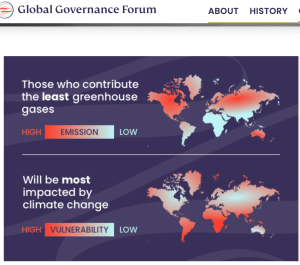
https://globalgovernanceforum.org/global-issues/climate-change/
Omar Abdou, a food security and M&E expert from Niger, lives a vulnerability to climate change there is indisputable. Sahelien production systems suffer the full brunt of the negative effects. Indeed, the essential rural activities, namely agriculture, and livestock which occupy at least 80% of the population, are becoming more and more uncertain as they rely on two pillars: rainfall and the exploitation of natural resources (soil, vegetation, other water sources). But, in recent decades, we have witnessed a drastic reduction in rainfall. In pastoral zones, this decrease is reflected in the degradation of the vegetation cover and the deficits in livestock-vital fodder. For instance, the fodder assessment from 2000 to 2020 for the Tahoua Region has been in deficit for 15 years. More and more recurrent and frequent crises seriously affect the main productive capital of households, which is the herd.

https://intraacpgccaplus.org/story/niger-centre-studies-climate-smart-agriculture-and-climate-finance/
Emergency sales of increasingly emaciated animals at a low price are growing to pay for consumer goods and to buy fodder to feed a few animals. These are kept for breeding after the crisis, but what used to be seasonal crisis (dry-season) has become chronic.
In agro-pastoral zones, agricultural production in the rainy season, which has changed its duration and strength, becomes uncertain to feed the household members. The harvest is often exhausted at most by the 6th month of the year for many households. Thus, there is no more food surplus to supply the area’s food needs where cereals are not grown. Suddenly, cereals become expensive and inaccessible for many families. Their coping strategies are diverse but not always effective. In pastoral settings, parents are forced to take their children out of school to go further south in search of food and pasture. Sometimes more sedentary agro-pastoralist farmers pledge or sell their land to pay for food. Those left behind who have nothing to sell, are forced to cut trees and sell the wood for charcoal, further degrading the environment. Unfortunately, Niger’s neighbors are now mostly at war, so these young men run the risk of being recruited by armed groups or are killed. In these conditions, there is serious instability where the means of production (natural and human) are sold for survival and overexploited natural resources decrease. Increasingly, it is practically impossible to talk about sustainability. It is, therefore, necessary to think of consistent and innovative projects to enable households to produce sustainably while preserving the ecosystem for future generations. Outlets such as migration of the able-bodied workers to neighboring countries to provide labor in the lean season work now but are unsustainable.
Jindra notes that 31 Oct the UN Climate Change Conference (COP26) begins. Climate science documents life-threatening effects such as Omar and billions of others are already experiencing around the ‘developing’ world. The IPCC Working Group report shows that “the world will probably reach or exceed 1.5 degrees C (2.7 degrees F) of warming within just the next two decades. Whether we limit warming to this level and prevent the most severe climate impacts depends on actions taken this decade. Only with ambitious emissions cuts can the world keep global temperature rise to 1.5 degrees C, the limit scientists say is necessary for preventing the worst climate impacts. Under a high-emissions scenario, the IPCC finds the world may warm by 4.4 degrees C by 2100 — with catastrophic results.” Erratic rainfall, greater heatwaves will affect 70% of all farmers and herders who rely on rain for their production and a new report on Adaptation to climate across West African shows aridity increasing, which must inform global development.
What can we do:
1- LISTEN AND ACT GLOBALLY: There are excellent resources to track demands that the Global North divest and stop subsidizing fossil fuels. For instance, “In 2017/18, the G7 collectively spent more on fossil fuel finance than on climate finance, according to analysis by Oil Change International. They allocated nearly $40bn that year.” Hypocrisy abounds as this Climate Change News article goes on to note that “Since the Paris Agreement was signed, G20 countries’ export credit agencies have provided 14 times as much support for fossil fuels as clean energy “to $64 billion a year, and investors still prioritize profit over planet & people.
2- LISTEN AND PRIORITIZE GLOBAL SOUTH VOICES: While funding demands for over $100billion to LDCs is a demand of COP26, the need to support local research and activist organizations who show measured results is mostly missing (more from Sweden here). Other resources include WRI’s Allied for Climate Transformation by 2025 podcast series among the most Climate Change vulnerable nations. “ACT2025 consortium to ensure voices from countries most exposed to climate change are heard, empowered, mobilized, and adequately supported in international climate negotiations.“ The series includes how countries such as Niger adapt to climate change. If nothing else, consider the tragedy of the loss of $1.5 billion in aid invested in Niger, not to mention the ensuing suffering global Northern consumption is unleashing on the global South.
3- DESIGN CLIMATE SMARTLY: Global Development needs to do much more climate-smart programming as 50 years of investments in foreign aid to ‘developing’ countries has already started to be threatened. What can be done? From sequestering the carbon content of soil via farming to fostering climate-smart agriculture, which, according to the UN’s FAO means “agriculture that sustainably increases productivity, enhances resilience (adaptation), reduces/removes GHGs (mitigation) where possible, and enhances achievement of national food security and development goals”. Importantly this involves productivity plus adaptation and mitigation against changes wrought by climate change.
4- MEASURE SUSTAINABILITY: Exciting measurements are beginning! Scotland is valuing its nature, and there are calls for The Rights Of Nature In Evaluation Of Environmental Sustainability. Jindra is consulting to a wonderful team at the Adaptation Fund. We are evaluating what could be sustained, and what withstood climatic changes is ex-post project sustainability and resilience evaluation. The Adaptation Fund on evaluating projects’ longer-term (3-5 year ex-post project closure) sustainability and, importantly their resilience to climate change. We are piloting these rare kinds of evaluations in six countries, starting with Samoa and Ecuador in 2021. As the Fund has funded over 100 projects in 100 countries, with almost 30 million participants, we have a rich array to choose from. Such a learning opportunity about what lasts and has withstood disturbances is vital. As the Fund notes: “Climate change is predicted to greatly affect the poorest people in the world, who are often hardest hit by weather catastrophes, desertification, and rising sea levels, but who have contributed the least to the problem of global warming. In some parts of the world, climate change has already contributed to worsening food security, reduced the predictable availability of freshwater, and exacerbated the spread of disease and other threats to human health. Helping the most vulnerable countries and communities is an increasing challenge and imperative for the international community, especially because climate adaptation requires significant resources beyond what is already needed to achieve international development objectives.”
5- TAKE PERSONAL RESPONSIBILITY: For 8 years, Valuing Voices has pushed back to evaluate the ‘Sustainable Development” we have promised for 50 years. We must be accountable primarily to our participants and partners, rather than donors, and only by listening to these country nationals, we can learn what was sustained not, why or why not, and what emerged from their efforts. In 2019, we wrote all of us are accountable to improve the SDGs. It is wonderful to have climate change leading organizations invest in ex-post evaluation that adds resilience, prioritizing organizational learning and accountability. We all must increase our awareness that curb our consumption, for the sake of Niger, small island states, and many other parts of our planet can no longer stand our business-as-usual. Limiting climate change begins with us, from changing our food consumption to consumer choices to political advocacy to seeing the Earth as indivisible from us and us from the Earth. Let us start to invest in global sustainability today.
Do you see any bright spots on the horizon? Do share!
by Jindra Cekan | Jul 15, 2021 | Accountability, Aid effectiveness, climate change, Covid, Financing gap, Impact Guild, International aid, Monitoring and Evaluation, post project evaluation, Private sector, SDGs, Sustainability, Sustainable development, Uncategorized
Sustainable Development Goals (SDGs), Funding and Accountability for sustainable projects?
What are Sustainable Development Goals? ” the United Nations adopted the new post-2015 development agenda. The new proposals – to be achieved by 2030- set 17 new ‘sustainable’ development goals (SDGs) and 169 targets. Some, like Oxfam, see the SDGs as a country budgeting and prioritization as well as an international fundraising tool. They cite that “government revenue currently funds 77% of spending…aligned with government priorities, balanced between investment and recurrent and easy to implement than donor-funded spending…” National investments are vital, but how much has the world used the SDGs to target investments and foster sustainable results?
Using results data such as that of the sectoral SDGs, countries can also ensure accountability for the policies implemented to reduce global and local inequities, but we must learn from the data. Over halfway to the goal, data is being collected, and while there is robust monitoring by countries who have built their M&E systems, other countries are faltering. “A recent report by Paris21 found even highly developed countries are still not able to report more than 40-50% of the SDG indicators” and “only 44% of SDG indicators have sufficient data for proper global and regional monitoring”. Further, there is very little evaluation or transparent accountability. Some of the data illuminate vitally need-to-know-for-better-programming. SDG data shows good news that Western and Asian countries have done better than most of the world 2015-19… but there is a lot of missing data while other data shows staggering inequities such as these:
- In Vietnam, a child born into the majority Kinh, or Viet, ethnic group is three and a half times less likely to die in his or her first five years than a child from other Vietnamese ethnic groups.
- In the United States, a black woman is four times more likely to die in childbirth than a white woman.
So are we using the SDG data to better target funding and improve design? This is the kind of evaluative learning (or at least sharing by those that are doing it :)) that is missing. As my colleague and friend Sanjeev Sridharan writes on Rethinking Evaluation, “As a field we need to more clearly understand evaluation’s role in addressing inequities and promoting inclusion” including “Promoting a Culture of Learning for Evaluation – these include focus on utilization and integration of evaluation into policy and programs.” How well learning is integrating is unknown.
As a big picture update on the progress of the Sustainable Development Goals (SDGs) in 2021, with only nine years left to the goal: It’s not looking good. The scorecards show COVID-19 has slowed down or wiped out many achievements, with 100 million people pushed into extreme poverty, according to the IMF. Pre-Covid, our blog on sectoral SDG statistics on health, poverty, hunger, and climate, was already showing very mixed results and a lack of mutual accountability.
The private sector is ever-being pushed to fund more of such development costs, only marginally successfully, as public sector expenditures are squeezed. Yet the G20 estimates that $2.5 TRILLION is needed every year to meet the SDG goals. As we have seen at Impact Guild, the push to incentivize private commitments is faltering. “To ensure its sustainability, the private sector has specific interests in securing long-term production along commodity supply chains, while reducing their environmental and social impacts and mitigating risks… The long-term economic impacts of funding projects that support the sustainability agenda are, thus, clearly understood. However, additional capital needs to flow into areas that address the risks appropriately. For example, much remains to be done to factor climate change as a risk variable into emerging markets that face the largest financing gap in achieving the SDGs.” Further, if decreased funding trends continue, by 2030, at minimum 400 million people will still live on less than $1.25 a day; around 650 million people will be undernourished, and nearly 1 billion people will be without energy access. So we’re not meeting the SDGs, they’re being derailed by COVID in places, and we aren’t beginning to cost out the need to address climate change and its effects on global development…. so now what?

From: https://www.g20-insights.org/policy_briefs/incentivizing-the-private-sector-to-support-the-united-nations-sustainable-development-goals/
To ensure that giving everyone a fair chance in life is more than just a slogan; accountability is crucial. This should include a commitment from world leaders to report on progress on “leaving no one behind” in the SDG follow-up and review framework established for the post-2015 agenda and for the private sector to loudly track their investments across the SDGs. For as The Center for American Progress wrote, money and results are key: We must “measure success in terms of outcomes for people, rather than in inputs—such as the amount of money spent on a project—as well as in terms of national or global outcomes” and that “policymakers at the global level and in each country should task a support team of researchers with undertaking an analysis of each commitment.”
A further concern. While we seem to measure the statistics periodically and see funding allocated to SDG priorities, but there are few causal links drawn between intensity in investment in any SDG goal and sustained results. To what degree are the donations/ investments into the SDGs linked to improvements? Without measuring causality or attribution, it could be a case of “A rising tide lifts all boats” as economies improve or, as Covid-related economic decline wiped out 20 years of development gains as Bill Gates noted last year. We need proof that trillions of dollars of international “Sustainable development” programs have any sustained impact beyond the years of intervention.
We must do more evaluation and learn from SDG data for better targeting of investments and do ex-post sustainability evaluations to see what was most sustained, impactful, and relevant. Donors should raise more funds to meet needs and consider only funding what could be sustained locally. Given the still uncounted demands on global development funding, we can no longer hope or wait for global mobilization of trillions given multiple crises pushing more of the world into crisis. Let’s focus now.